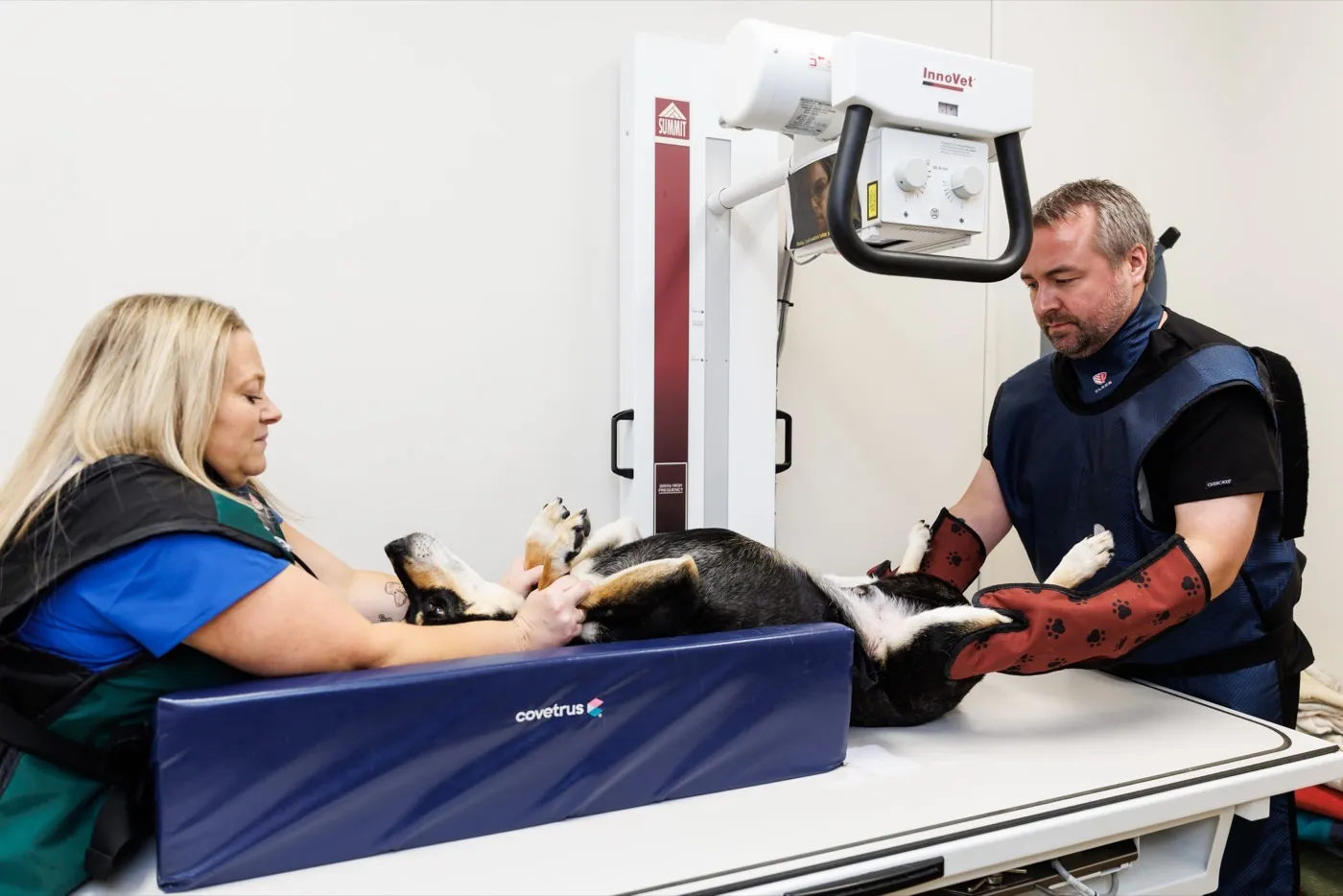
Digital X-rays for dogs and cats
At Cleary Lake Veterinary Hospital, we offer digital radiography (X-rays) for dogs and cats to help our veterinary team quickly and accurately evaluate a wide range of medical conditions. Digital X-rays provide detailed images of the bones and internal structures, helping us diagnose injuries, arthritis, fractures, joint problems, heart and lung conditions, abdominal concerns, and other abnormalities. Digital imaging allows our veterinarians to review images quickly and share them with specialists when needed, helping us make informed decisions about your pet’s care. Our goal is to provide efficient, high-quality diagnostic imaging while keeping your pet as comfortable and safe as possible throughout the process.

What to expect when your pet needs X-rays
X-rays can often be taken during the same visit as your pet’s exam. Our team gently positions your pet for each view, and usually more than one view is needed for a complete picture. Taking each image only takes a moment.
Many pets do fine awake. If your pet is painful, anxious or needs to stay very still, we may recommend sedation, and we will give you any instructions about food ahead of time. Because the images are digital, your veterinarian can review them quickly and talk through the results with you.

When X-rays can help your pet
Your veterinarian may recommend X-rays if your pet:
- Is limping, has been injured or may have a fracture
- Is coughing or breathing differently
- Is vomiting or may have swallowed something they should not have
- Is a senior pet with stiffness or suspected arthritis
- Needs a closer look at the heart, lungs or abdomen
We also offer PennHIP evaluations for dogs. X-rays are often one step in a workup and may be combined with bloodwork or ultrasound to get the full picture.
Have questions about your pet’s imaging?
If your pet is limping, coughing or just not acting like themselves, call us at (952) 435-8387 to schedule an exam. We will let you know if X-rays could help.
Digital Radiography - FAQ
Are X-rays safe for my pet?
Yes. Taking X-rays is painless, and each exposure is brief and uses a low dose of radiation. Shielding protects the rest of your pet’s body and the team. X-rays show bones, large body cavities and some swallowed objects well, while soft tissues show up less clearly, which is when ultrasound may be recommended. Source: Merck Veterinary Manual
Will my pet need to be sedated for X-rays?
Not always. Many X-rays are taken with the pet awake and gently held in position. Sedation may be recommended when a pet is painful or anxious, or when holding perfectly still is important for a clear image. If sedation is needed, we will explain why and what to expect before we start. Source: Cornell University Companion Animal Hospital
Can a specialist look at my pet’s X-rays?
Yes. Digital X-rays can be sent electronically, so images can be shared with a board-certified veterinary radiologist or another specialist when a second opinion would help. Radiologists are veterinarians with advanced training in reading X-rays and other imaging, and their report can guide next steps in your pet’s care. Source: Penn Vet Ryan Veterinary Hospital
Why does my limping dog need X-rays?
Limping is a sign of a problem, not a diagnosis. After watching your dog walk and feeling the legs and joints, your veterinarian may recommend X-rays to look for fractures, arthritis, joint problems or other changes in the bones. Ultrasound or other imaging is sometimes added, and sedation may be used to reduce pain and stress. Source: Merck Veterinary Manual
Can X-rays check my dog’s hips?
Yes. X-rays help show how much arthritis is present in dogs with hip dysplasia and guide treatment planning. Breeds at risk are often evaluated with specialized hip X-rays before breeding. Our hospital also offers PennHIP hip evaluations. At home, watch for bunny hopping, stiffness or limping that worsens after exercise. Source: Merck Veterinary Manual


