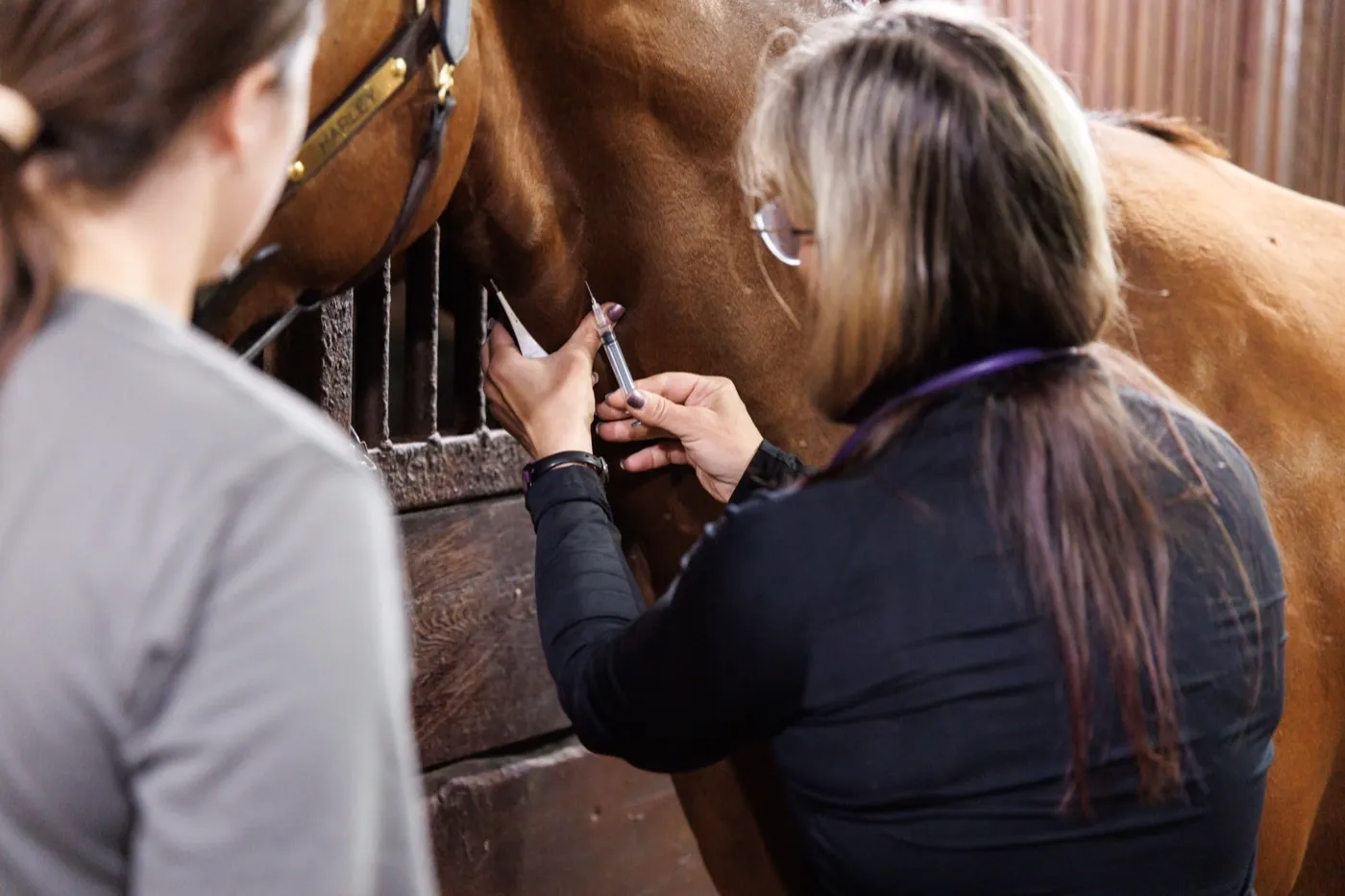
Our in-house equine laboratory
In-House Laboratory Services at Cleary Lake Veterinary Hospital allow our veterinary team to perform a variety of diagnostic tests quickly and efficiently. Our in-house laboratory capabilities help provide timely results for bloodwork, reproductive testing, health screenings, and other diagnostic needs, allowing our veterinarians to make informed treatment decisions and provide prompt care for your horse. We are also an APHIS-approved EIA testing laboratory, providing Equine Infectious Anemia (Coggins) testing for horses.
What to expect when your horse needs lab work
Most testing starts with a quick blood draw, usually from the jugular vein in the neck, which most horses tolerate well. Depending on the question, your veterinarian may also collect other samples, such as manure, urine or reproductive samples. Because many tests are run right here at the hospital, results come back quickly, so treatment decisions do not have to wait on an outside lab.
Your veterinarian will go over the results with you and explain what they mean for your horse’s care.
When is lab work useful for your horse?
Your veterinarian may recommend testing:
- Each year for a Coggins test before travel, shows, boarding or a sale
- As part of a wellness check, especially for older horses
- When your horse has a fever, weight loss, poor appetite or colic
- To monitor a long-term condition or medication
- For mares in a breeding program
- Before anesthesia or surgery
Lab results add information that a physical exam alone cannot provide, which helps your veterinarian choose the right next step.
Need a Coggins test or bloodwork?
Call (952) 435-8387 to schedule a visit with our equine team.
Equine In-House Laboratory - FAQ
What is a Coggins test, and when does my horse need one?
A Coggins test is a blood test for equine infectious anemia (EIA). A negative result is generally needed each year, and it is commonly required before a horse is sold, enters a boarding facility, travels between states or attends a competition. Testing is recommended even for horses that stay home. Source: University of Illinois College of Veterinary Medicine
Why is equine infectious anemia taken so seriously?
EIA is a lifelong viral infection spread between horses mainly by biting flies such as horseflies and deer flies. Some infected horses look healthy but still pose a risk to others. There is no specific treatment or vaccine, which is why testing and controls on positive horses are so important. Source: Merck Veterinary Manual
Who can draw blood for a Coggins test in Minnesota?
In Minnesota, blood samples for EIA tests must be drawn by an accredited veterinarian. If a horse is found to be infected, the Board of Animal Health quarantines it, and it must be kept permanently isolated in a screened enclosure or at least 200 yards from other horses. Exposed horses are retested. Source: Minnesota Administrative Rules (Board of Animal Health)
What can bloodwork tell my veterinarian?
A chemistry panel measures substances in the blood that reflect how organs are working, including the liver, kidneys and muscles, along with protein and electrolyte levels. Some tests are especially useful in horses. For instance, GGT helps show longer-term liver damage. Results are read as a pattern, together with a complete blood count. Source: Merck Veterinary Manual
Why do results come with a “normal range”?
Each value is compared with a reference range, the span of results expected in healthy horses. For instance, a typical packed cell volume in horses falls roughly between 27% and 43%. Reference ranges vary between laboratories, so results should always be compared with the ranges provided by the lab that ran the test. Source: Merck Veterinary Manual


